Blog

  • 3D model at construction site

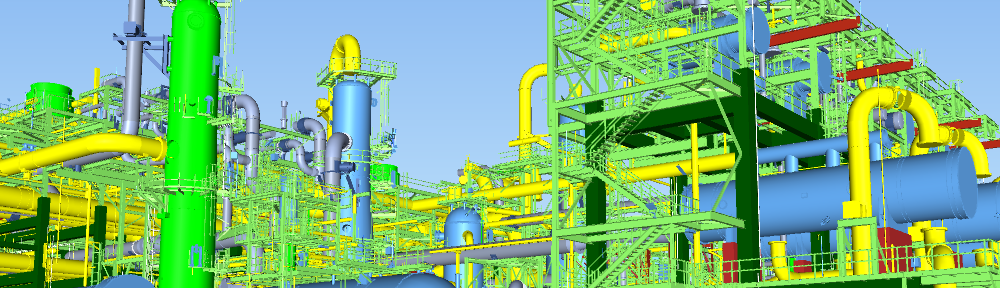
    How was the 3D model created?

    For industrial area common practice is to make an EPCI tender. Where E – means Engineering, which includes FEED study.

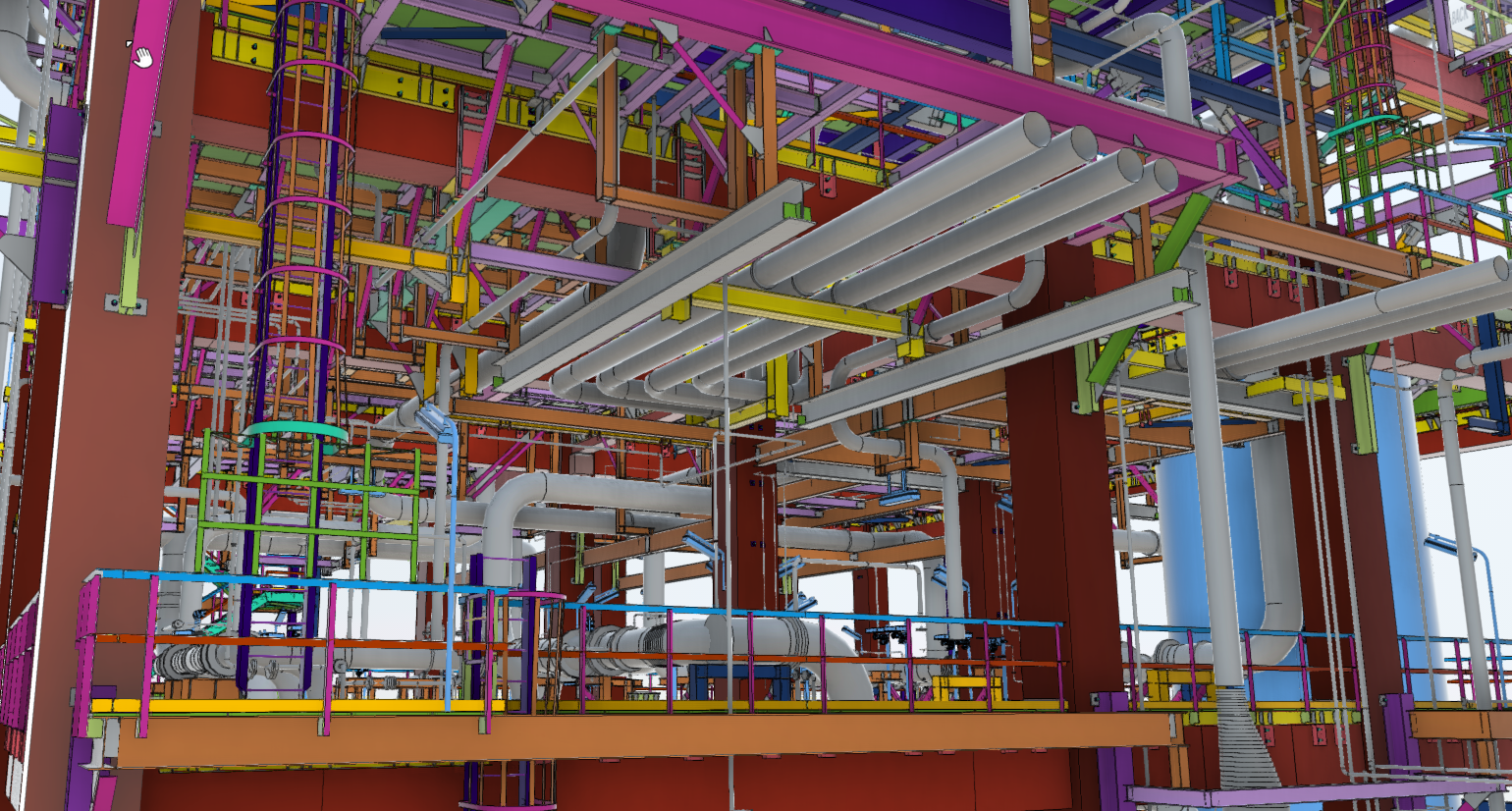
    Rough 3D model appears at FEED study to help briefly estimate expenses, clarify technical details, define approximate facility layout.

    When Final Investment Decision is made – Engineering start to model facility with all details.
    Basically, 3D model is a product of engineering processes, as well as drawings, take off quantities, and specifications.

    Who uses 3D model in Construction?

    Engineers – use 3d model to create a detailed drawing, estimate quantities,

    prevent clashes btw disciplines (pipe vs concrete wall vs HVAC, etc).

    In last decade it became also more common to see at construction site due to fact of improvement of 3D model quality and liberation of 3D tools for model review

    (IFC standard, NavisWorks Freedom, Web Based online viewers)

    It’s faster to check 3D model at site, rather than make a clarification request to Engineering

    If in case of drawings issues – some labels might be missed, some sections might do not have detail dimension.

    For some models 2d slices might be hard to read as is, but these all start to make sense when you see 3D.

    What is the input for 3D model?

    Engineering take input from Client requirements and Technology schema developed for project.

    Based on this data engineers estimate, calculate, and  make model with respect to safety, constructability, local regulations, and extreme physical challenges:

    • Significant snow load and extreme low temperatures in Arctic
    • Extreme high temperatures in Middle East
    • Risk of explosions and fire for Petrochemical facilities
    • Extreeme pressure for sub see projects
    • Criogenic temperatures for LNG projects

    And of course – tight timeframe schedule it always challenge by it self. Reducing time from construction start to finish – create massive impact on project revenue.

    What are the the major advantages of the 3d Model

    In general 3D model increase cost of engineering due to high cost of licenses and manhours required for modeling processes.

    Result – more accurate detailed information for constructions, with impressively less mistake rates.

    • 3D model allows to spot clashes btw disciplines, subcontractor before it reach construction process. Each mistake at Construction stage cost a lot of money and cause delays.
    • Give same point of view for Engineers, Managers, Client specialists: 
      • accurate 3D model easier manage due technical review, rather than infinite stack of Drawings and Tables.
      • Its better to see 3D rather than comparing dimensions btw barely related drawings.
    • This accuracy allow to make more dense structures, due to fact that each dimension is reliable, before it was common to modify dimensions at site.
    • This reliability of element dimensions allow to scatter work load among fabricators, instead of receiving raw materials at site, project can rely on prefab elements. This reduce cost and time, give a maneuver to scale up productivity by involve several fabrication facilities among the globe
    • As result we get more detailed and reliable documentation for Procurement and Construction processes. Which also improve maintenance at execution stage of facility.

    Is this a process that is new at Construction site?

    3D modeling process for Facility engineering – used for decades, start with Oil And Gas fields, and became mandatory for basically every industial facility.

    Now a days 3D model became point of interest for all parties (EPCI Contractor, Client, Subcontractors).

    Key difference is cloud based tools became available in recent years, which give reliable ground for colaborative activites.

    With online tracking systems each element might be tracked from drawings to fabrication, painting, shipping, erection.

    With cloud based data analisys solutions such as PowerBI – we can get insights out of this data.

    With liberated 3D model all this data became Reliable tools for analyze and manage construction data in terms of fabrication, erections, commissioning readiness.

    What are the points to be mindful with the 3D model

      Common mistake among 3d evangelist – is that 3D model shall remove drawings from process at some point.

      In reality – drawing detail based on 3D model is a key factor to ensure 3D model validity for project requirements,

      fabrication standards and quality demands.

      Hight quality of 3D is not achievable without detailed 2D drawings and vice versa.

      For construction site – 3D model is useful tool to resolve question if 2D details is not clear.

      Now with Digitalization progress in terms of Construction Progress tracking, with new cloud-based

      Data Analysis tools, and Web based Model review  – company  able to utilize 3D for:

      • Constructability study,
      • define short and mid terms Priorities,
      • check Subcontractor progress and progress data,
      • Identify impact of incidents at module and area based due to Material shortage, Damage, Erection stage of different disciplines.
      • Another important task is to Calculate current available Workfront.  

      Engineering model give Total Workfront, construction operate with a plan for coming 1-2-3 months and only partial concreate scope.

      It’s important to hire right number of employees to do the job at site based on

      fabrication progress, stock availability, construction progress.

      If one of Piperack column is in delay due to transportation damage, or casting mistake,

      even if we had pipes available at site layout, we cannot consider it as Workfront for the moment.

      Such details is about to resolve by Construction Management team, and 3D became essential tool for:

      – communication,

                      – progress analysis

      – subcontractor progress review

                      – data consistency check

                      – short term planning based on Data

                      3D model is essential to Data Driven Construction methodology implementing at site. Which is key requiremet for facilitation of AI tools at Construction Landscape.

    1. NavisWorks C# Api Sections

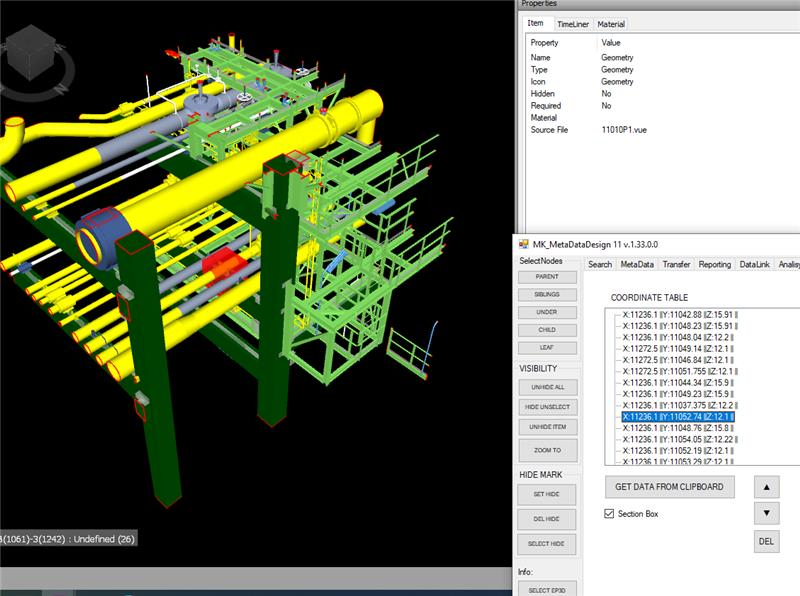
      NavisWorks C# API Section Tools enable sectioning via c# .Net and COM

      Often its’ important to have some code snippets to be able to solve concreate task in NavisWorks via .NET API at C# language. Cause documentations is not always self explanatory. Especially in case COM API. So for Cutting and Section planes in navis samples Bello is able to do the job.

      CONTENT

      By Xiaodong Liang

      Origin was available here: http://adndevblog.typepad.com/aec/2012/08/create-sectioning-plane.html

      Currently, only COM exposed some small API for sectioning. InwClippingPlaneColl can add the custom clipping plane. But InwClippingPlaneColl.Add method is not supported. This is because the COM wrapper in having to follow the underlying C++ code.
      You need to use InwClippingPlaneColl2.CreatePlane. It passes in a 1 based index. Default planes will be created as required, up to and including this index. Then you modify the plane that is in the collection directly.

              private void createSectionPlane()
              {
                  ComApi.InwOpState10 state;
                  state = ComBridge.State;
      
                  // create a geometry vector as the normal of section plane
                  ComApi.InwLUnitVec3f sectionPlaneNormal =
                      (ComApi.InwLUnitVec3f)state.ObjectFactory(
                      Autodesk.Navisworks.Api.Interop.ComApi.nwEObjectType.eObjectType_nwLUnitVec3f,
                      null,
                      null);
                  sectionPlaneNormal.SetValue(1, 1, 0);
      
                  // create a geometry plane
                  ComApi.InwLPlane3f sectionPlane =
                      (ComApi.InwLPlane3f)state.ObjectFactory
                      (Autodesk.Navisworks.Api.Interop.ComApi.nwEObjectType.eObjectType_nwLPlane3f,
                      null,
                      null);
      
                  //get collection of sectioning planes
                  ComApi.InwClippingPlaneColl2 clipColl =
                      (ComApi.InwClippingPlaneColl2)state.CurrentView.ClippingPlanes();
      
                  // get the count of current sectioning planes
                  int planeCount = clipColl.Count + 1;
      
                  // create a new sectioning plane
                  // it forces creation of planes up to this index.
                  clipColl.CreatePlane(planeCount);
      
                  // get the last sectioning plane which are what we created
                  ComApi.InwOaClipPlane cliPlane =
                      (ComApi.InwOaClipPlane)state.CurrentView.ClippingPlanes().Last();
      
                  //assign the geometry vector with the plane
                  sectionPlane.SetValue(sectionPlaneNormal, 1.0);
      
                  // ask the sectioning plane uses the new geometry plane
                  cliPlane.Plane = sectionPlane;
      
                  // enable this sectioning plane
                  cliPlane.Enabled = true;
              }

      Create NavisWorks Section Box via .Net API

      With .Net Api section box might be created as valid JSON object and assign to current View:

      private void createSectionPlane(double centerX, double centerY, double CenterZ)
      {                                
      
      double halfSize = 5;
      string clippingPlanesJson = 
                 "{\"Type\": \"ClipPlaneSet\"," +
                  "\"Version\":1,\"OrientedBox\":" +
                 "{\"Type\":\"OrientedBox3D\"," +
                  "\"Version\":1,\"Box\":" +
      "[" +
          "[";
      clippingPlanesJson += (centerX - halfSize).ToString() + ",";
      clippingPlanesJson += (centerY - halfSize).ToString() + ",";
      clippingPlanesJson += (centerZ - halfSize).ToString() + 
      "],[" +
      clippingPlanesJson += (centerX + halfSize).ToString() + ",";
      clippingPlanesJson += (centerY + halfSize).ToString() + ",";
      clippingPlanesJson += (centerZ + halfSize).ToString() + 
           "]" +
      "],";
      clippingPlanesJson += "\"Rotation\":[0,0,0]},\"Enabled\":true}";
                                      Autodesk.Navisworks.Api.Application.ActiveDocument.ActiveView.SetClippingPlanes(clippingPlanesJson);

      Add Sections Planes via Bridge COM

      Add Sections Planes via Bridge COM

      published att Autodesk Forum by bvgarbar

      private void CreateSectionBox(Document doc, DocumentCurrentSelection selection)
      {
      var currentViewPoint = doc.CurrentViewpoint;
      var viewPointValue = currentViewPoint?.Value;
      var planes = viewPointValue?.InternalClipPlanes;
      if (planes == null) return;
      
      planes.SetMode(LcOaClipPlaneSetMode.eMODE_BOX);
      if (planes.GetMode() != LcOaClipPlaneSetMode.eMODE_BOX) return;
      BoundingBox3D box = selection.SelectedItems.BoundingBox();
      //planes.FitToBox(box);
      planes.SetBox(box);
      planes.SetEnabled(true);
      currentViewPoint.Value.ZoomBox(box);
      }

    2. How to create a Table and fill in its cells with .NET

      originally this article was available at

      https://adndevblog.typepad.com/autocad/2012/05/how-to-create-a-table-and-fill-in-its-cells-with-net.html

      But now this source is not available anymore. So this is copy paste from web-archive for my own memory

      05/16/2012

      How to create a Table and fill in its cells with .NET

      By Xiaodong Liang

      The code below shows how to create a table and fill in its cells. Some obsolete methods of Table are still visible. You will receive a warning in compiling if using obsolete methods. Please use the newest methods.

      [CommandMethod("testaddtable")]
      public void testaddtable()
      {
          Database  db =
              HostApplicationServices.WorkingDatabase;
       
          using (Transaction tr =
              db.TransactionManager.StartTransaction())
          {
              BlockTable bt =
                  (BlockTable)tr.GetObject(db.BlockTableId,
                                          OpenMode.ForRead);
              ObjectId msId =
                  bt[BlockTableRecord.ModelSpace];
              BlockTableRecord btr =
                  (BlockTableRecord)tr.GetObject(msId,
                                      OpenMode.ForWrite);
              // create a table
              Table tb = new Table();
              tb.TableStyle = db.Tablestyle;
              // row number
              Int32 RowsNum = 5;
              // column number
              Int32 ColumnsNum = 5;
              // row height
              double rowheight = 3;
              // column width
              double columnwidth = 20;
      
              // insert rows and columns
              tb.InsertRows(0, rowheight, RowsNum);
              tb.InsertColumns(0, columnwidth, ColumnsNum);
              tb.SetRowHeight(rowheight);
              tb.SetColumnWidth(columnwidth);
      
              Point3d eMax = db.Extmax;
              Point3d eMin = db.Extmin;
              double CenterY = (eMax.Y + eMin.Y) * 0.5;
              tb.Position = new Point3d(10, 10, 0);
      
              // fill in the cell one by one
              for (int i = 0; i < RowsNum; i++)
              {
                  for (int j = 0; j < ColumnsNum; j++)
                  {
                      tb.Cells[i, j].TextHeight =  1;
                      if (i == 0 && j == 0)
                          tb.Cells[i, j].TextString =
                              "The Title";
                      else
                          tb.Cells[i, j].TextString =
                              i.ToString() + "," + j.ToString();
                      tb.Cells[i,j].Alignment =
                          CellAlignment.MiddleCenter;
                  }
              }
      
              tb.GenerateLayout();
              btr.AppendEntity(tb);
              tr.AddNewlyCreatedDBObject(tb, true);
              tr.Commit();
          }
      }
    3. ABIM (Attribute Block Information Model)

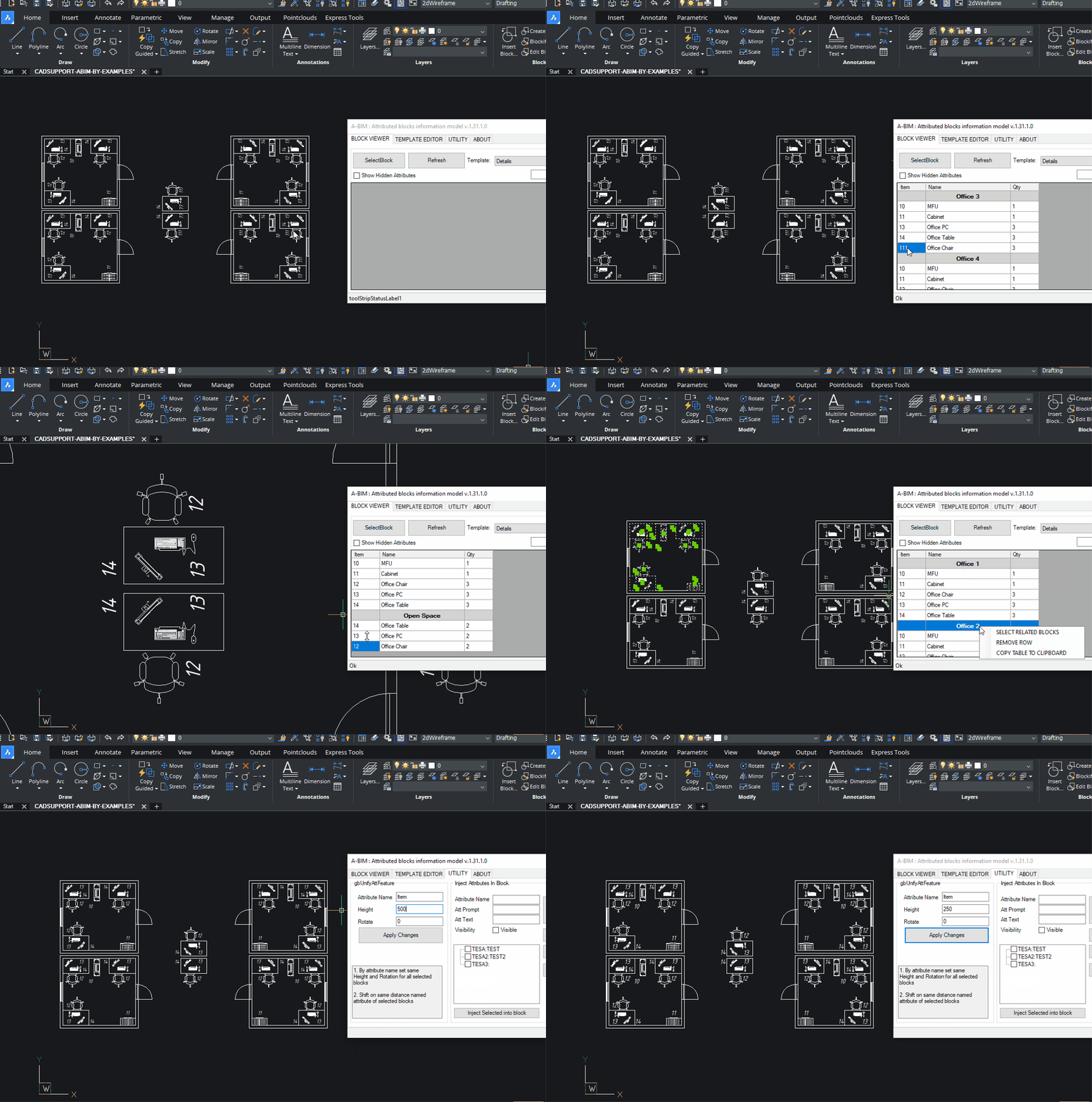
      A design pattern for 2D/3D CAD engineering, where meaningful elements are created as blocks with defined attributes.

      With this approach, each item in a drawing is not merely a collection of lines and circles—it becomes an object containing both graphical and meta information.

      ABIM is intended to save time for engineers on projects that are either not significant enough or not specifically suited for full BIM modeling. This includes various types of diagrams and plans such as:

      • P&ID (Piping and Instrumentation Diagrams)
      • Small HVAC layouts
      • Piping, electrical, automation and technology plans and diagrams
      • Melioration and agricultural projects

      These can be created in 2D or 3D, whenever it is more cost-effective, faster, or more practical to design using traditional CAD systems.

      ABIM allows the engineer to focus on the model itself, while all related schedules, tables, and documentation are automatically generated as derivative products of the block model.

      Key Features

      Based on predefined Templates

      Order and sort as you expected, 1, 2, 17, 21 (other apps is 1,17,2,21)

      Group, subgroup and etc. aggregation

      Block arrays, infinite nested blocks,

      Dynamic blocks with visibilities (visibility is attribute as well)

      Easy to manage template editor with filters

      Aggregate by concatenation.

      Dynamic props considered as attributes

      Edit group attributes values in table at once

      Unify block instance attribute

      Select blocks and groups in model from table

      Export and import of templates

      Attributes injection to blocks

    4. BricsCAD – autoload .net app

      If you write a plugins in .Net and want to make this app available in BricsCad after startup seems the most reliable way is to add following keys to you Registry:

      Windows Registry Editor Version 5.00
      
      [HKEY_LOCAL_MACHINE\SOFTWARE\Bricsys\ObjectDRX\V21x64\Applications\YourApplicationName]
      "Loader"="C:\\Temp\\YourAssembly.dll"
      "Managed"=dword:00000001
      "LoadCtrls"=dword:00000002
      "Description"="Your description"
      Where LoadCtrls = 2 is loading at startup.


      Seems there is not much info about Registry structure details at documentatation but there is some:

      https://help.bricsys.com/en-us/document/knowledge-base/installation/bricscad-registry-structure?id=165245343756

      and this one is about how to get/set BricsCAD templates and references folders:


      https://help.bricsys.com/en-us/document/knowledge-base/installation/when-and-how-is-bricscad-initialized-using-root-folders?id=165245343864

    5. ABIM for BricsCAD

      Each time you need to get a Take of, or calculate project cost, make a Bill of Materials or list of equipments – ABIM is your best choice. Now works with BricsCAD

    6. NavisWorks C# Pick Point

      Lest deep dive in Autodesk NavisWorks api.

      First, we need a tool plugin with mouse down Interceptor:

      using Autodesk.Navisworks.Api;
      using Autodesk.Navisworks.Api.Plugins;
      
          [Plugin("PickModelPointPlugin", "ADSK")]
          class PickModelPointPlugin : ToolPlugin
          {
              public override bool MouseDown(View view, KeyModifiers modifiers,
                                               ushort button, int x, int y,
                                               double timeOffset)
              {
                      // get current selection
                      PickItemResult pickedResult = view.PickItemFromPoint(x, y);
      
                      if (pickedResult != null)
                      {
                          Autodesk.Navisworks.Api.Point3D clickedPoint =          
                                                              pickedResult.Point;
      
                      // Sent to static exchange, to make click result available 
                      // for Addin Plugins in namespace
                      // convert to custom Point, to reduce coupling. 
                      StaticExchange.PickedPoint = new cPoint(clickedPoint.X,
                                                              clickedPoint.Y,
                                                              clickedPoint.Z);
                      }
                  return base.MouseDown(view, modifiers, button, x, y, 
                                        timeOffset);
              }
          }

      First, we need a tool plugin with mouse down Interceptor:

         class StaticExchange
          {
              public static event PointDelegate PointUpdate;
              public delegate void PointDelegate(PointEventArgs e);
              private static cPoint point;
      
              public static cPoint PickedPoint
              {
                  get {
                          return point;
                      }
                  set {
                          point = value;
                          PointUpdate?.Invoke(new PointEventArgs(point));
                      }
              }
          }

      Obviously, we may need to do some actions as soon as user click on something. That`s why event delegate has been presented in StaticExchange.
      Finally, in our Addin we call A plugin and await for result. In my case it’s a form with buttons, so on a button I bind click handler:

      private async void btnPickNavisPoint_Click(object sender, EventArgs e)
      {
            try { 
                  //search for plugin availability 
                  ToolPluginRecord toolPluginRecord =                    
                         (ToolPluginRecord)ANA.Application.Plugins
                             .FindPlugin("PickModelPointPlugin.ADSK");
              //set Plugin for execution                                
              ANA.Application.MainDocument.Tool
                  .SetCustomToolPlugin(toolPluginRecord.LoadPlugin());
                      //Subscribe on event
                      StaticExchange.PointUpdate += onPointUpdate; 
                      //Patiently wait for result
                      Point3D result = await WaitForUserChoiceAsync();
      
                      MessageBox.Show(
                          "Point: "+
                           "X:" + result.X.ToString("0.##") + " " +
                           "Y:" + result.Y.ToString("0.##") + " " +
                           "Z:" + result.Z.ToString("0.##") + " ");
                  }
                  catch (Exception ex)
                  {
                      MessageBox.Show(ex.Message);
                  }
                  finally
                  {
                      //Unsubscribe and switch back to Tool.Select
                      StaticExchange.PointUpdate -= onPointUpdate; 
                      ANA.Application.MainDocument.Tool.Value = Tool.Select;
                  }
              }

      And now final peace – where magic is live.

      1. Declare TaskCompletionSource,
      2. Wrap it into WaitUserChoice.
      3. In event handler call Source and pass argument.
              private TaskCompletionSource<Point3D> _userChoiceTcs;
      
              private async Task<Point3D> WaitForUserChoiceAsync()
              {
                  // Create a new TaskCompletionSource for this operation
                  _userChoiceTcs = new TaskCompletionSource<Point3D>();
                  try
                  {
                      Point3D result = await _userChoiceTcs.Task;
                      return result;
                  }
                  finally
                  {
                      // Clean up
                      _userChoiceTcs = null;
                  }
              }
      
              private void onPointUpdate(PointEventArgs p)
              {
                  //Here come the user click result
                  _userChoiceTcs?.TrySetResult(new Point3D(p.Point.X,
                      p.Point.Y,
                      p.Point.Z));
              }

      As a result we got message with coordinates of clicked points, as soon as user click on some object.

    7. Hello world!

      Welcome to WordPress. This is your first post. Edit or delete it, then start writing!